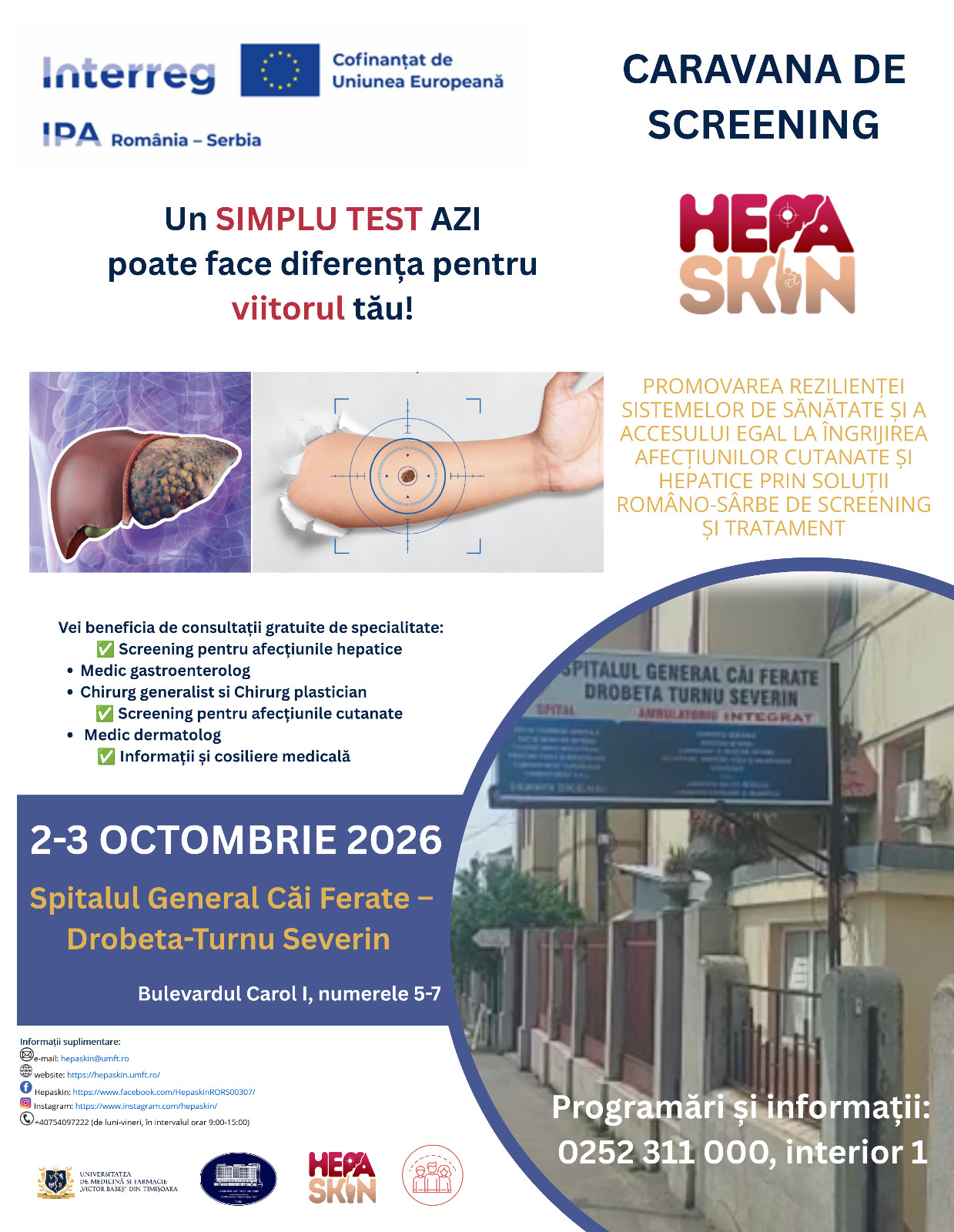


Activities and Project Steps

About the structure of the HepaSkin project

The HepaSkin project is organized into several Work Packages (WP) that ensure a coordinated and efficient implementation of planned activities. Each WP has clear objectives, measurable results, and a responsible team to deliver outcomes within the established timeline.

Implementation calendar

The project stages span 24 months, with parallel activities for management, data collection, statistical analysis, and dissemination.

Activity
T1 2025
T2 2025
T3 2025
T4 2025
T1 2026
T2 2026
T3 2026
T4 2026
WP1 – Raising Awareness on Skin Cancer
WP2 – Knowledge Exchange and Innovative Training (Skin)
WP3 – Skin Cancer Screening and Treatment
WP4 – Raising Awareness on Liver Cancer
WP5 – Knowledge Exchange and Innovative Training (Liver)
WP6 – Liver Cancer Screening and Treatment
WP7 – Development of Cross-Border Medical Registries

Activities and project steps

Purpose:
To inform the cross-border population about the prevention and early detection of skin cancer.
Main activities:

  • Public awareness and education campaigns on risk factors and prevention methods;
  • Distribution of informative materials (brochures, posters, videos);
  • Events and workshops dedicated to raising awareness of UV exposure risks;
  • Media collaboration for spreading public health messages.

Expected results:
Increased public awareness of skin cancer and greater participation in screening programs.

Purpose:
To strengthen the professional capacity of medical staff in dermatology and skin oncology.
Main activities:

  • Theoretical and practical training courses for dermatologists and surgeons;
  • Joint Romania–Serbia sessions for experience exchange and best practices;
  • Presentation of modern diagnostic methods such as dermatoscopy and videodermatoscopy;
  • Creation of a cross-border medical network for skin disease care.

Expected results:
20 trained specialists integrated into a shared platform for medical collaboration.

Purpose:
To implement a joint screening and treatment program for skin cancer addressing the Romanian and Serbian population.
Main activities:

  • Organizing free dermatological screening campaigns;
  • Early diagnosis of suspicious skin lesions;
  • Surgical interventions for confirmed cases;
  • Data collection and submission to shared registries.

Expected results:
2,000 people examined and 100 surgical interventions performed, with direct impact on public health.

Purpose:
To promote the importance of early detection of liver cancer and the prevention of liver diseases among the cross-border population.
Main activities:

  • Information campaigns about causes and symptoms of liver cancer;
  • Distribution of educational materials in medical centers and local communities;
  • Promotion of liver screening and healthy behavioral changes;
  • Media and public communication activities supported by medical experts.

Expected results:
Improved awareness regarding the importance of testing and early diagnosis of liver diseases.

Purpose:
To develop professional competencies in gastroenterology, hepatology, and hepatic surgery.
Main activities:

  • Workshops and joint training sessions for Serbian specialists;
  • Presentation of modern diagnostic technologies (contrast ultrasound, elastography, advanced imaging);
  • Courses on managing liver cancer patients;
  • Strengthening medical and scientific cooperation between partner institutions.

Expected results:
20 specialists trained and capable of applying modern diagnostic and treatment methods for liver diseases.

Purpose:
To ensure equitable access to diagnosis and treatment for patients with liver conditions through a shared screening program.
Main activities:

  • Organizing free liver screening campaigns (ultrasound, lab tests, imaging);
  • Early identification of suspected cases;
  • Referral of confirmed patients to partner medical centers for treatment;
  • Integration of data into the joint Romania–Serbia registries.

Expected results:
2,000 people examined, 50 surgical interventions performed, and ongoing post-treatment monitoring.

Purpose:
To create and operate two joint medical registries — one for skin cancer and one for liver cancer — for patient monitoring and statistical analysis of incidence.
Main activities:

  • Designing and developing electronic registries;
  • Integrating data collected from screening campaigns;
  • Training personnel in system use;
  • Ensuring sustainability and maintenance after project completion.

Expected results:
Two operational registries, with over 350 patients registered by the project’s end and database expansion through 2029.

HepaSkin Newsletter

The latest updates on project activities, screening campaigns, research findings, and useful medical resources.